
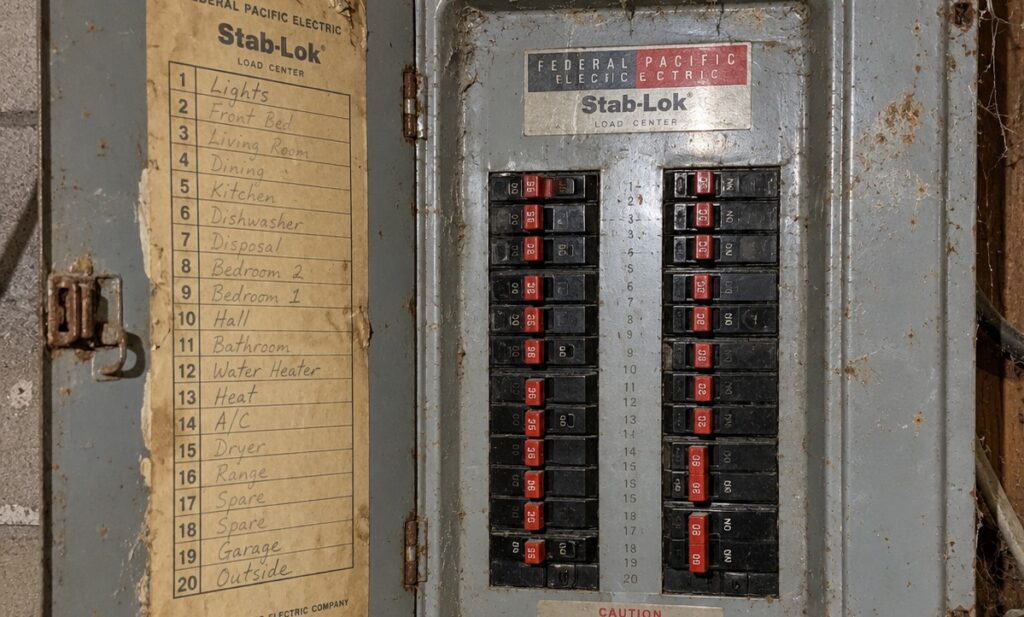
The air conditioner is running. The refrigerator is cold. Every light comes on. Your electrical system must be safe, right? Not necessarily. A panel box can distribute electricity throughout your home while failing at its most important job: shutting off power when something goes wrong.
Federal Pacific Electric (FPE) Stab-Lok, Zinsco, and certain Sylvania panel boxes deserve special attention. These older systems have documented concerns involving breakers that fail to trip or connections that overheat. Here is what homeowners and buyers need to know.
1.The Circuit Breaker: Your Unseen Protector
A circuit breaker should interrupt electricity when an overload or short circuit occurs. Without that protection, excessive current can overheat wiring and damage insulation, creating a fire hazard inside walls where you may never see it developing.
A breaker that has never tripped is not proof that everything is safe. It may never have faced a fault—or it may be unable to respond properly when one occurs. Turning the circuit breaker on and off does not prove that its automatic protective mechanism works.
2.FPE Stab-Lok: When the Breaker Does Not Trip
Federal Pacific Electric Stab-Lok breakers have a history of failing certain safety tests. The U.S. Consumer Product Safety Commission confirmed failures of UL calibration requirements during its investigation. These tests evaluate whether breakers respond to excess current within specified limits.
The danger is a failure to trip. If a Stab-Lok breaker allows excessive current to continue flowing instead of disconnecting the circuit, wiring can overheat. The lights may stay on while the protection you are counting on fails to do its job.
Do not confuse the circuit breaker switch with the protective mechanism inside. Flipping a Stab-Lok breaker OFF and ON is not a test of whether it will trip automatically during an overload. A panel that looks clean, and a breaker that moves normally, cannot establish reliable protection.
You may hear, “They were never recalled, so they must be safe.” That conclusion is misleading. The CPSC closed its investigation in 1983 without determining whether the breakers were safe. Closing the investigation was not a safety approval.
Look for names such as Federal Pacific Electric, FPE, or Stab-Lok on visible labels. If you suspect this equipment is present, arrange evaluation by a Licensed, Professional Journeyman Electrician and discuss replacement.
3.Zinsco and Sylvania: A Hidden Connection Problem
Zinsco panels have another serious concern: the connection between the circuit breakers and the metal bars that distribute electricity are called bus bars. Poor connections can create arcing and intense heat. Breakers can become damaged or melt to the bus bars, compromising protection and increasing fire and shock risks.
Some damaged breakers may still conduct electricity even when their handles appear to be OFF. That makes it especially dangerous to assume a circuit is safe to work on simply because someone flipped a switch.
Some panels sold under Sylvania or GTE-Sylvania use the Zinsco design and share these concerns. However, not every Sylvania panel uses that design. A Licensed Professional should identify the actual equipment before making a replacement recommendation. The brand name alone does not tell the whole story.
4.“It Has Worked for Years!”
This is understandable, but years of electricity flowing through a panel do not prove that it will shut down safely during a fault. Hidden damage may also be present even when the front of the panel looks clean.
For FPE Stab-Lok and confirmed Zinsco-design panels, complete panel replacement is the recommended safety approach. Replacing an individual breaker does not establish that the remaining breakers or panel connections are safe.
A home inspection should identify the equipment and visible concerns. It cannot certify the internal operation of every breaker or guarantee future performance.
5.What Should Homeowners Do?
*Arrange professional evaluation. Have a licensed electrician identify the panel and explain the appropriate replacement plan.
*Leave the cover and breakers in place. Do not remove the metal cover, pull breakers, or deliberately overload a circuit to test it. Parts inside can remain energized even with the main breaker off.
*Take warning signs seriously. Burning odors, crackling, buzzing, discoloration, or melted components require urgent attention. Do not approach or operate a panel showing signs of active failure. If there is smoke, sparking, or fire, leave the home and call 911.
*Plan before closing. If you are buying a home with one of these panels, obtain an electrician’s evaluation and replacement estimate during your inspection period.
You do not have to wait for flickering lights or a burning smell to address a known concern. Your panel’s most important job happens when something goes wrong. That is the moment you need its protection to work.
Inspections of Texas cares about what is hidden behind the things that appear to work. We inspect every property like we’re buying it—because your family’s safety matters!